
Choosing a Pet Portrait Photo: What Makes It Your Cat or Dog?
The funniest photograph of your dog may show a nose pressed against the lens. Your favorite picture of your cat may be a small bundle asleep in a large patch of sun. Both can be worth keeping. Neither necessarily shows the information you would want someone to preserve in a portrait.
Before choosing oil paint, a cartoon or a royal costume, ask a more useful question: which visible details make this your animal rather than simply a member of the same breed? A broad label such as “brown tabby” leaves a lot undecided. The shape of the cheeks, an uneven white patch, the spacing of the eyes and the outline of the ears can give you more concrete things to compare.
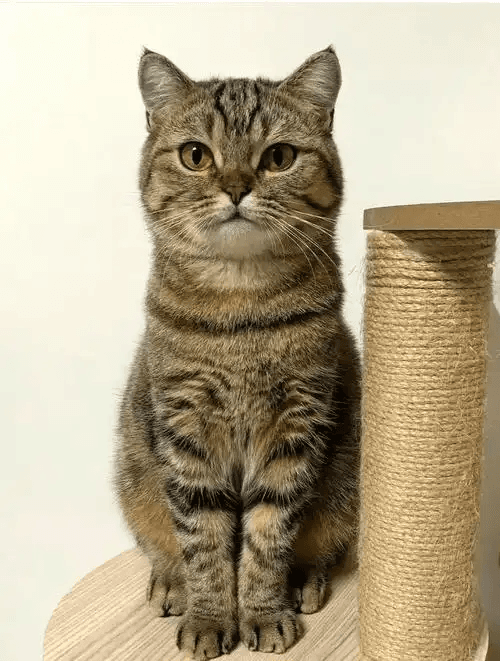
This guide uses an existing demonstration cat image for a framing exercise, followed by two separate style references. They are not photographs supplied by customers, and the references are not results produced from the demonstration cat. We are comparing visible choices, not testing a generation model.
A close crop can show more and tell you less
Look at the three views below. They use the same file; only the presentation changes. The first contains the full demonstration image. The second gives more room to the head. The third deliberately pushes the crop too far.
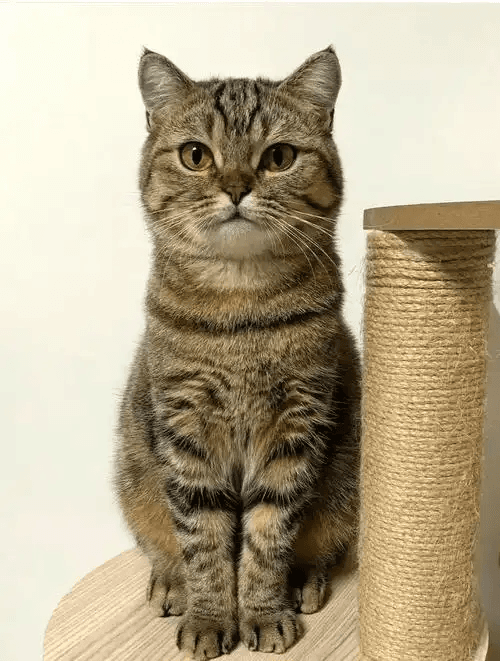
In the full view, the paws, striped legs and scratching post help describe the scene. That is useful if what you love is the cat sitting in its usual place. For a head portrait, however, much of the available area is occupied by objects other than the face.
The middle view makes the cheek outline, dark forehead stripes, nose and ears easier to inspect together. The ears matter here because they are part of the head's outline, not because every pet portrait needs identical framing. A dog with floppy ears may need considerably more room at the sides.
The last view makes the eyes larger but cuts the ear tips. It has gained face area by discarding information. If the distinctive part of your pet is a notched ear, that exchange would defeat the purpose.
I would use the middle view as a starting point for this particular head portrait. For a painting about the cat's everyday surroundings, I would keep more of the first. “Fill the frame” is not a complete instruction until you decide what must stay inside it.
Write down three details before you look at styles
Choose details you can actually check against the photograph. For the demonstration cat, I would start with the broad cheeks, the dark forehead pattern and the nose-and-muzzle shape. These are a working checklist for this picture, not a claim that they uniquely identify this animal.
For your own pet, the list might instead be a white muzzle that rises higher on one side, one folded ear and a long narrow face. A front view cannot establish a marking on the back; a side view cannot show both eyes. No single photograph has to document everything, but it must show the things you intend to preserve.
Compare two candidate photos at a comfortable size. If you cannot tell whether a dark area is fur or shadow, prefer the picture where the boundary is clearer. If a strong warm light changes the apparent coat color, compare with another familiar picture before treating that orange tone as a marking. More visible fur texture will not resolve an ambiguous boundary by itself.
For a digital head portrait, I would usually favor an image with the eyes and muzzle in focus, unobstructed ears and some space around the head. A dramatic wide-angle nose close-up can be charming; it is a less straightforward reference if your goal is ordinary facial proportions.
A style can hide the very feature you care about
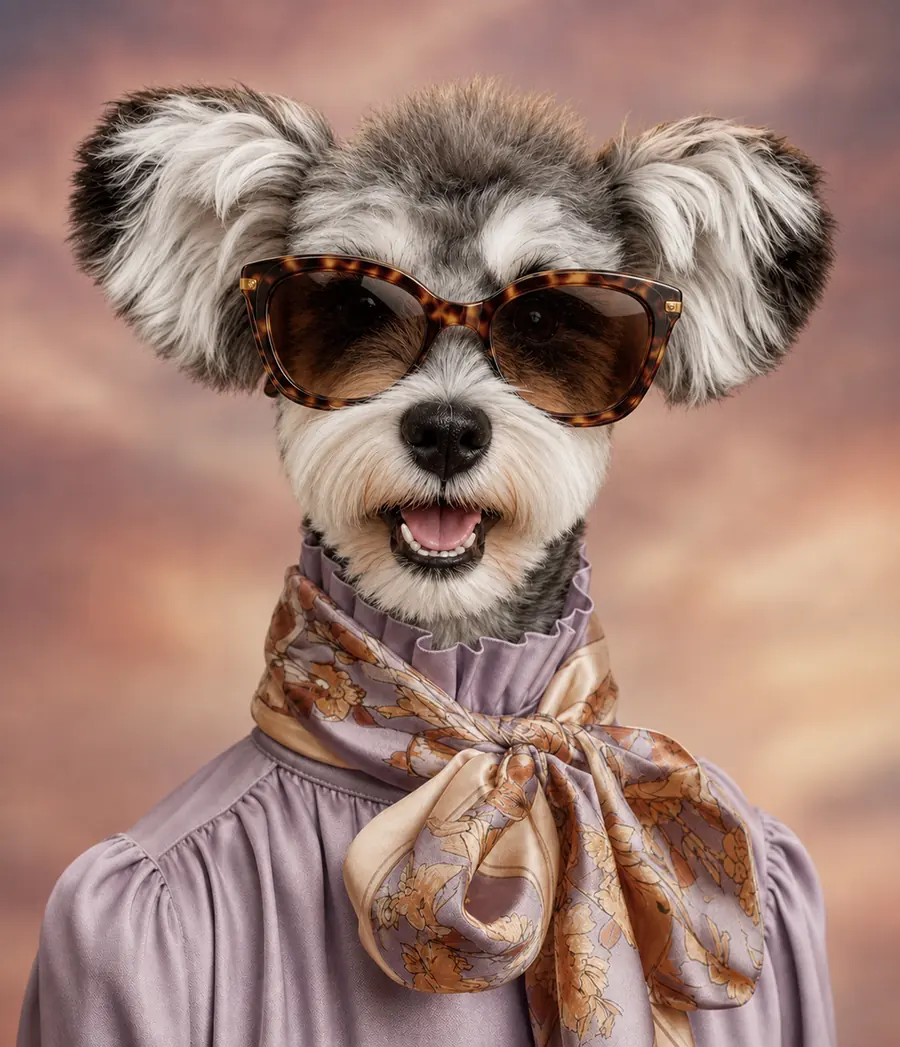
Existing style reference: “Sunset Sunglasses,” from Pawsible’s reference gallery. This is a separate animal, not an edited version of the cat above.
The glasses, scarf and lifted mouth make this picture a coherent costume portrait. The gray-and-white ear fur is still visible, as are the nose and pale muzzle. But the dark lenses cover the eyes. If the eye shape or different eye colors are what you want the portrait to preserve, the accessory competes directly with that goal.
That does not make the reference a bad choice. You might want a playful dressed-up version and be happy for the sunglasses to take the lead. The useful decision is to make that trade consciously, rather than choose the costume and later be surprised that the eyes are unavailable for comparison.
A crown can leave the eyes open and still change the hierarchy. An elaborate collar can make the head appear small relative to the costume. Ask what the styling hides, what it emphasizes and how much of the picture it occupies.
Simplified fur is different from changed markings
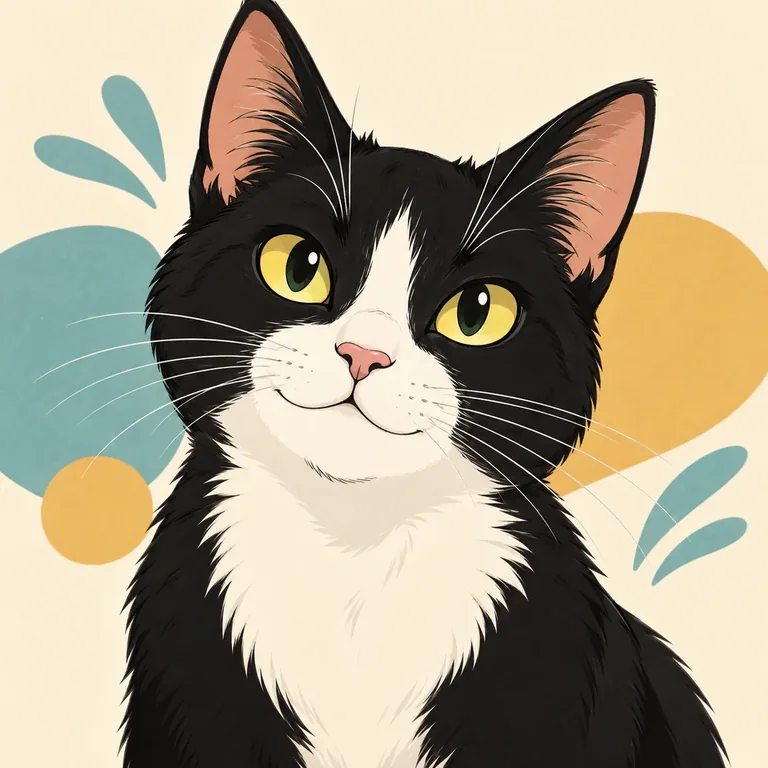
Existing drawn style reference from Paw Portrait Lab's cartoon gallery. It is not a transformation of the demonstration cat.
Here the black coat is organized into large shapes. Individual hairs are suggested around the ears and cheeks, while much of the body reads as a dark mass. The white blaze, pink nose and pale chest carry a great deal of the visual structure.
Imagine choosing this approach for a pet with an uneven blaze. Keeping every individual hair would be less important than keeping the white patch on the correct side and preserving its broad boundary. A smoother drawing could still honor that feature. A richly textured image with a symmetrical patch could miss it.
This is why I would separate two questions when assessing a stylized portrait: has the rendering become simpler, and has the animal's pattern changed? The first may be the intended style. The second may be a reason to choose another version.
Pick the photograph for the portrait you actually want
| Intended portrait | Information I would prioritize | Detail I might accept losing |
|---|---|---|
| A recognizable head portrait | Eyes, muzzle, ear outline and distinctive facial markings | The room, toys and most of the body |
| A portrait about a familiar pose | Body proportions, paws, posture and enough surroundings | A very large face in the frame |
| A playful costume picture | A few visible personal features plus room for accessories | Some coat detail; possibly eyes if choosing sunglasses |
| A simplified illustration | Large coat patches and the head's outline | Individual strands and fine photographic texture |
These are starting choices, not promises about what any tool will preserve. When you inspect a finished picture, return to the three features you named before choosing the style. Check left and right markings against the source, compare the muzzle and ear shape, and decide whether the expression still feels familiar to you. A pleasing new animal is a different outcome from a pleasing portrait of your animal.
If no photograph shows the required details clearly, a new ordinary photograph may be more useful than another elaborate style. Let the animal remain comfortable; choose a quiet moment instead of trying to force a pose for the sake of a reference.
If you want to try a visual direction after making that selection, the pet portrait page offers references to compare with a photo you have permission to use. For the broader question of what survives when an image becomes an account icon, read why a beautiful photo is not always a good profile picture.