
Gaming Avatar Ideas: Choose the Character Before the Effects
“Make it look like a game character” can mean several different pictures. An armored portrait asks you to look at a person in a world. A pixel wizard can work as a symbol for a role. A neon street scene makes clothing and location part of the identity. Adding more glow does not settle which of those you want.
A useful gaming avatar brief names what should identify the character even after you remove some of the effects. It might be your face in imagined equipment, a hat-and-beard silhouette, or a repeated blue-and-black palette. Once that is clear, you can decide which details are supporting it and which are competing for attention.
The three references here depict different fictional characters. They are existing visual references, not official game portraits, customer results or a same-person comparison. The crop exercise uses one unchanged file. We are reading their visual choices, not measuring player recognition.
An armored portrait can still put the person first
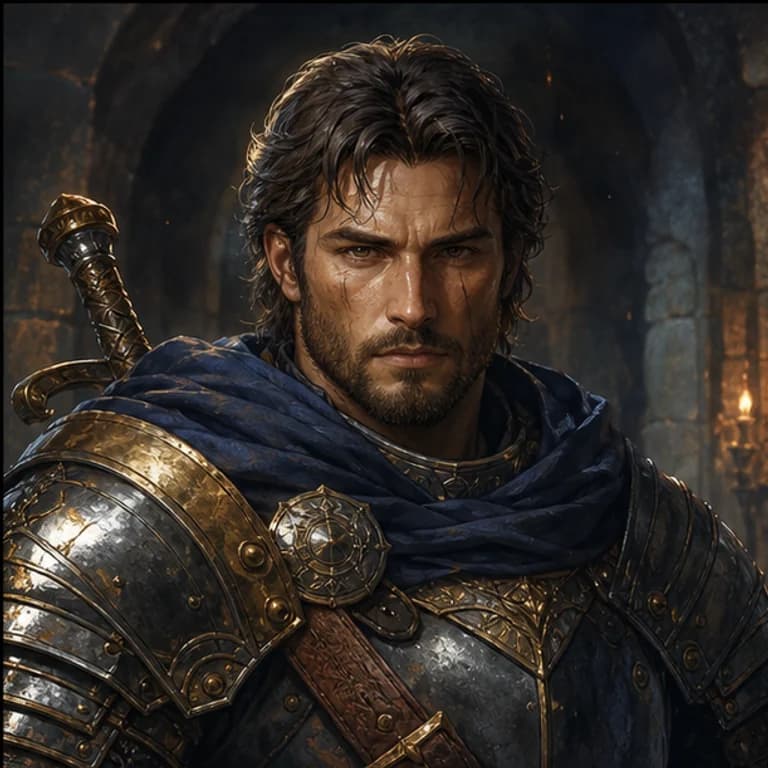
The metal shoulder occupies a large part of this portrait. Its bright reflections and small ornaments are immediately available to inspect. Yet the face remains unobstructed: hair, brow, nose, mouth and beard all have space in the center. The blue scarf separates the neck from the busy armor.
Notice what is doing the narrative work. The sword hilt and shoulder plate suggest an equipped character without needing a full battle scene. If I wanted a version that still felt like a particular person, this would be a useful hierarchy to borrow: an open face, one strong equipment shape and a quieter setting.
I would not copy every scratch on the metal into a brief. Those scratches provide texture; they are less useful as a stable feature you can describe from memory. Nor would I assume this reference's facial scars, beard or jaw should become yours. They belong to the depicted character. Borrowing equipment and lighting is a different decision from borrowing the person wearing them.
If your imagined role depends on a helmet covering the face, accept that the helmet's shape may become the identifying cue. A hidden face cannot simultaneously carry the same visible personal detail as an open one. Neither choice is wrong, but they solve different problems.
The pixel wizard makes a different promise
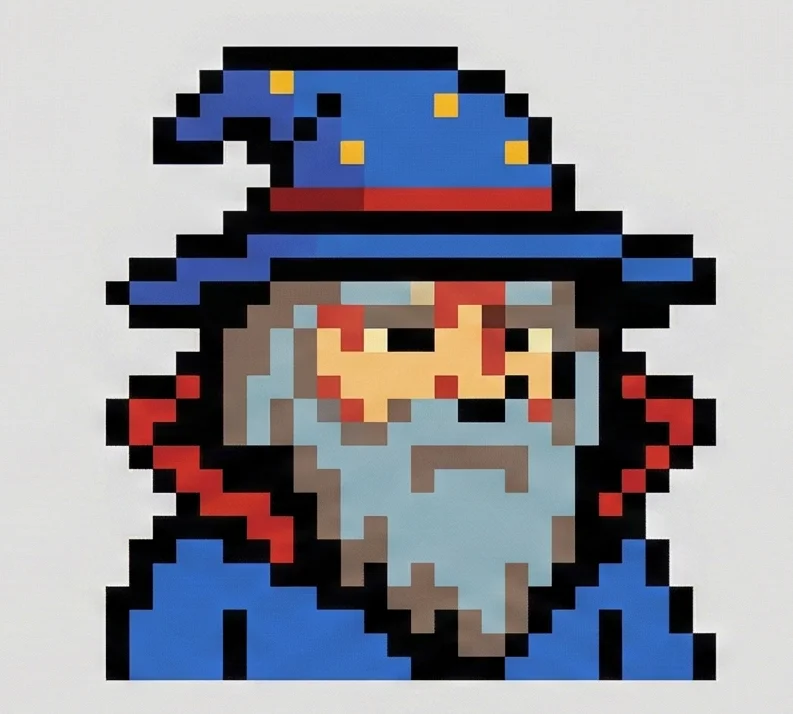
The blue hat, red band and gray beard make this character readable without photographic skin detail. A few large color groups and a stepped outer edge do much of the work. The yellow squares decorate the hat; the heavy outline separates it from the pale background.
There is very little room here to distinguish the exact shape of a real person's nose or subtle differences in eye spacing. That is not a defect if you want a role emblem. It becomes a mismatch if you expect a close facial likeness simply because the subject started as your photograph.
I would choose this direction when the account should feel like “the wizard with the blue hat.” I would choose a less simplified portrait when the account should feel like “me, playing a wizard.” Writing those two sentences is more useful than choosing between “high detail” and “low detail” in the abstract.
Also separate a blocky appearance from an export specification. This reference is an ordinary raster image with a pixel-like design. It does not establish a required pixel grid or file size for any platform. Enlarging a tiny image and choosing a deliberately blocky illustration are different operations.
A world can disappear when you crop for a face
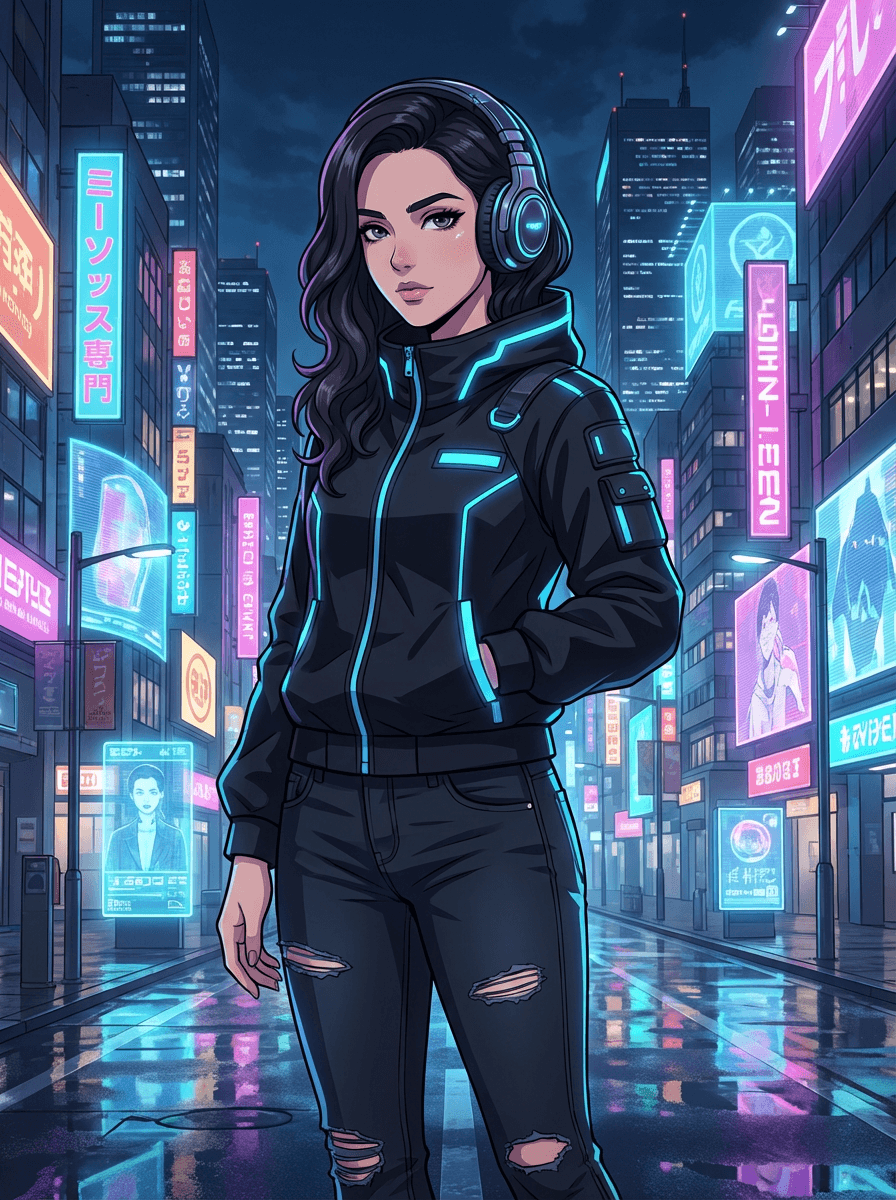
Full reference and head crop from the same file. This is a framing demonstration, not a new generated result.
In the full image, the headphone arcs, cyan jacket trim, illuminated signs and reflected street colors work together. The outfit and surroundings establish a sci-fi setting. The face is only one part of that arrangement.
The closer crop retains the headphones and much less of the street. It gives the face a different share of the frame, but it also changes how the world is described. If the headphones are the cue you wanted, the crop may be enough. If you fell in love with the full outfit, city signs and wet pavement, a head crop removes much of the reason you chose the reference.
That is a reason to give the wider scene a different job, such as a larger profile illustration, rather than keep adding miniature buildings around a face. For the avatar, you could preserve a single cue from the world: the cyan trim, a visible headset or one recognizable piece of equipment. The location does not need to be reconstructed in every square.
This example also shows why a close-up reference and a full-body reference are not interchangeable just because both are called cyberpunk. One offers a head-and-gear arrangement; the other offers a person inside a place.
Make a three-part brief you can judge afterward
Start with three short lines. Avoid words such as “epic” until you can say what they refer to in a picture.
| Decision | A concrete brief | What to check in the result |
|---|---|---|
| Identity | My hair part and round glasses remain visible | Equipment has not covered them or replaced the face with the reference character |
| Role | A traveler with one worn shoulder plate | The role reads through a clear object, rather than many unrelated props |
| Visual emphasis | A dark blue palette with one cyan accent | Bright accents support the chosen cue rather than compete in every corner |
That is one possible brief, not a rule that everyone must retain a face or use three colors. A symbol account could instead name a broad hat, a beard outline and a red band. The point is to make the intended identity inspectable.
When a result disappoints, describe the mismatch at the same level. “The visor covers the glasses” suggests changing the equipment reference. “The face is too small because the sword and shoulders dominate” suggests another framing. “It looks like someone else” calls for checking the facial changes, not simply increasing the amount of neon.
Changing one major choice at a time also makes it easier to understand why you prefer the next version. Replacing the face, palette, background and costume together leaves you with a different image but little knowledge of what solved the problem.
Choose the direction that matches the account
For a character that still represents your appearance, I would start with an open-face portrait and restrained equipment. For a symbolic player identity, I would start with a silhouette and palette I could describe without zooming in. For world-building, I would keep the larger scene and create a related, simpler avatar rather than force the whole environment into it.
The Discord avatar comparison looks more closely at attention in small message-list pictures. The anime portrait guide examines which personal features to retain in a drawn face. If you want to try a character direction with your own photo, compare the gaming avatar references after deciding which cue matters most.